

CEDF and AEDF: What the Heavy-Equipment Technician Shortage Means for Automotive Employers
The 2026 CEDF-AEDF report quantifies demand for technicians in Canada. An analysis of the findings, training, and salary benchmarks in Quebec.
2hr Technology — Editorial Team
Editorial team
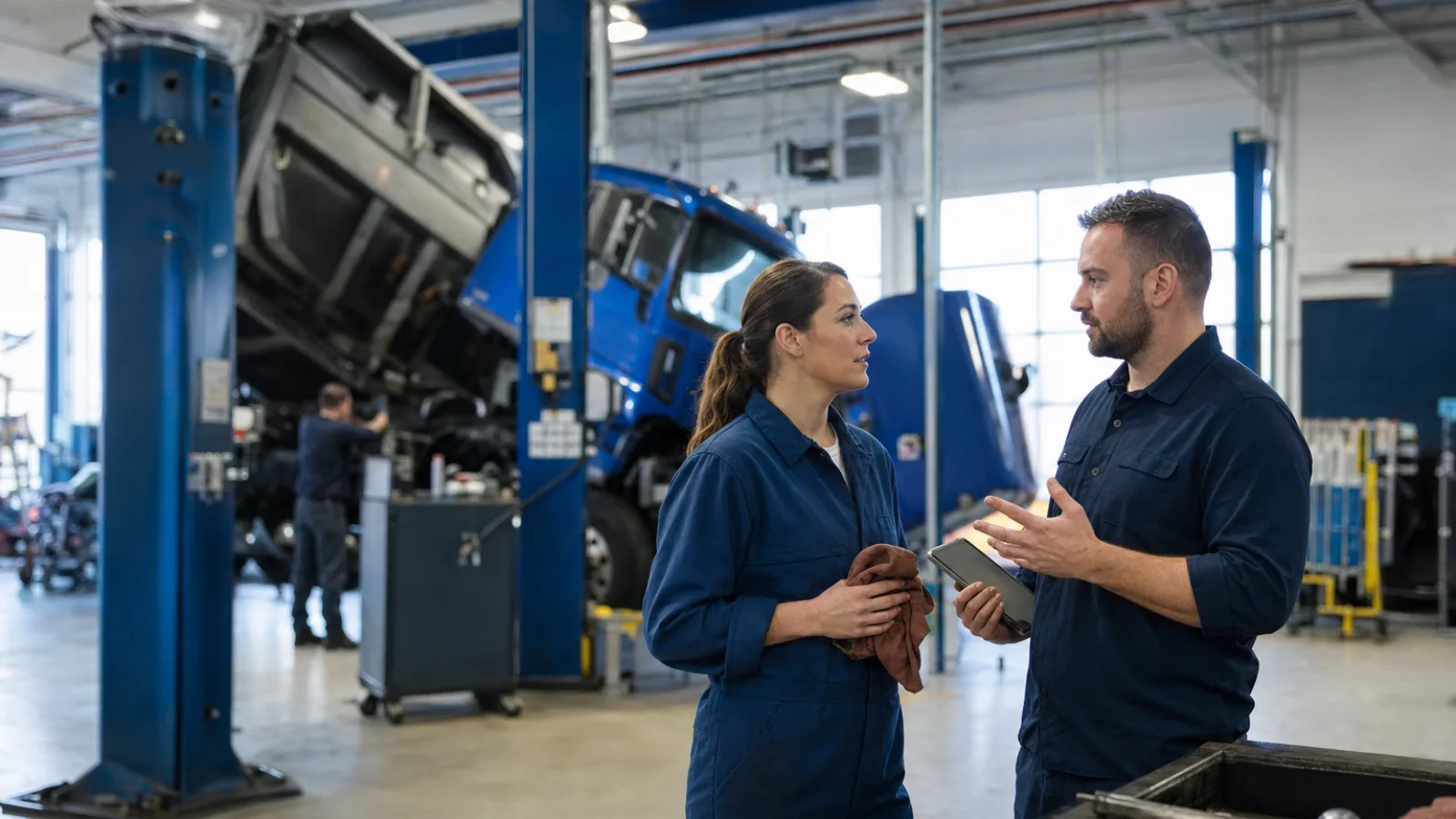
A shop may have the equipment, the customers and the work to do, yet lack the staff to take it on. The 2026 report from CEDF and AEDF examines this challenge among Canadian agricultural machinery and construction equipment dealers. For the automotive sector, it offers points for consideration, but it is not a directly transferable picture. According to Randall Reilly, which conducted the study, recruitment and retention are now limiting these businesses’ ability to meet demand. (randallreilly.com)
A targeted survey, not an automotive census
The Canada Equipment Dealers Foundation, or CEDF, and the Associated Equipment Distributors Foundation, or AEDF, commissioned Randall Reilly to conduct this research. The report is dated July 2026; its release was announced on September 18, 2026, in the North American Equipment Dealers Association’s magazine. Its primary focus is agricultural and construction equipment dealers. (equipmentdealermagazine.com)
The methodology describes data collection conducted from January to March 2026. On the Canadian side, 46 responses were reduced to 40 company records after deduplication and consolidation. This is therefore an industry survey supplemented by interviews, not an exhaustive census. The report does not publish a separate result that would make it possible to measure the situation in Quebec precisely. (aedfoundation.org)
This distinction matters to automotive employers: recruitment challenges observed in the machinery sector do not, on their own, quantify the needs of automotive repair shops.
Hiring needs should not be confused with vacancies
The report cites a projection of 26,500 heavy equipment mechanic job openings from 2024 to 2033, across all sectors. This total includes both replacement needs and job creation; it does not mean there are 26,500 current vacancies. For agricultural and construction equipment dealers alone, the authors estimate annual needs of 1,263 technicians, combining replacement needs with three-year growth targets. (aedfoundation.org)
The reported financial impact is CAD 803 million per year in lost service and parts revenue. Under Randall Reilly’s methodology, this estimate is based on assumptions about billing and sales associated with unfilled positions. It is a model of potential lost revenue, not an accounting of actual losses or an estimate of lost net profit. (randallreilly.com)
Dealers’ responses nevertheless point to tangible operational pressure. According to the September 2026 launch announcement, 78% of respondents said they could not meet demand because of a shortage of technicians, 62% said the shortage was holding back their growth, and 25% reported vacancies lasting more than 150 days. These percentages describe the responding companies, not all Canadian shops. (equipmentdealermagazine.com)
A national risk does not erase local realities
Federal projections support the diagnosis of sustained labour-market pressure. Employment and Social Development Canada began publishing its new projections on October 30, 2026. For heavy equipment mechanics, the Canadian Occupational Projection System indicates a strong risk of shortage for 2026 to 2035. This updated time frame should be distinguished from the 2024 to 2033 period used in the CEDF-AEDF report. (occupations.esdc.gc.ca)
In the shorter term, however, Quebec’s outlook is less clear-cut. Job Bank rates the outlook for heavy equipment mechanics as moderate in Quebec for 2025 to 2027. It expects opportunities related to growth and retirements, while also noting that experienced workers are looking for jobs. A projected national shortage does not mean that every employer in every region faces the same challenge. (guichetemplois.gc.ca)
Recruiters are therefore better served by starting with the specific trade, regional labour pool and required skills than with a blanket claim that “mechanics are in short supply everywhere.”
Automotive salary benchmarks in Quebec
Compensation calls for the same precision. Canada Motor Jobs’ 2025 salary estimates, based on union collective agreements and statistics from its job platform, provide benchmarks by trade, region and experience. They are neither officially observed averages nor guaranteed earnings.
For a journeyperson mechanic with three to five years of experience, the following annual ranges apply, in gross Canadian dollars:
| Region | 2025 annual salary estimate |
|---|---|
| Greater Montreal | $83,000–$86,000 |
| Greater Quebec City | $78,020–$80,840 |
| Laurentians–Lanaudière | $78,020–$80,840 |
| Gatineau / Outaouais | $76,360–$79,120 |
| Sherbrooke / Eastern Townships | $73,870–$76,540 |
| Drummondville / Centre-du-Québec | $73,040–$75,680 |
| Trois-Rivières / Mauricie | $72,210–$74,820 |
| Victoriaville / Bois-Francs | $70,550–$73,100 |
Experience also changes the point of comparison. In Greater Montreal, these estimates range from $74,000 to $79,000 for a journeyperson with one to two years of experience, and from $89,000 to $91,000 for one with six years or more.
For an apprentice in Montreal, the 2025 benchmarks are $50,000 to $54,000 at one to two years of experience, and $58,000 to $62,000 at three to five years.
These ranges apply to the automotive service department. They should not be presented as salaries for agricultural machinery or construction equipment technicians studied by CEDF and AEDF.
Train and retain, rather than simply post vacancies
The dealers surveyed are considering measures such as expanding on-the-job training and strengthening support for employers who train technicians. According to their September 2026 announcement, 72% of respondents planned to increase compensation during 2026. These are stated intentions, not increases whose implementation has been confirmed. (equipmentdealermagazine.com)
The workforce pipeline is not standing still, however. According to Statistics Canada, Canada recorded 101,541 new apprenticeship registrations in 2024, across all trades. In the heavy equipment mechanic group, the number of certifications issued in 2024 was 41.5% higher than in 2019. This growth adds nuance to the idea that the next generation of workers has simply disappeared, but it does not show that demand is being met. (www150.statcan.gc.ca)
Training also takes time. In Ontario, the pathway described by Skilled Trades Ontario for heavy equipment technicians generally includes 7,000 hours, comprising 6,280 hours of on-the-job training and 720 hours in class. These provincial requirements illustrate why hiring an apprentice is not an immediate substitute for hiring an experienced technician. (skilledtradesontario.ca)
For an automotive shop, the practical takeaway could be straightforward: assign a mentor, set aside time for training and explain the pay progression at the time of hire. Candidates can ask who will support them, which skills will be assessed and how their progress will be recognized.
Conclusion
The CEDF-AEDF report invites employers to treat recruitment as a service-capacity issue, not simply a matter of how visible their vacancies are. For automotive employers, the key is less to repeat its figures than to define their own offer clearly: transparent compensation, structured training and a credible path for advancement. Those are also points candidates can use to assess their next shop.